- Insight
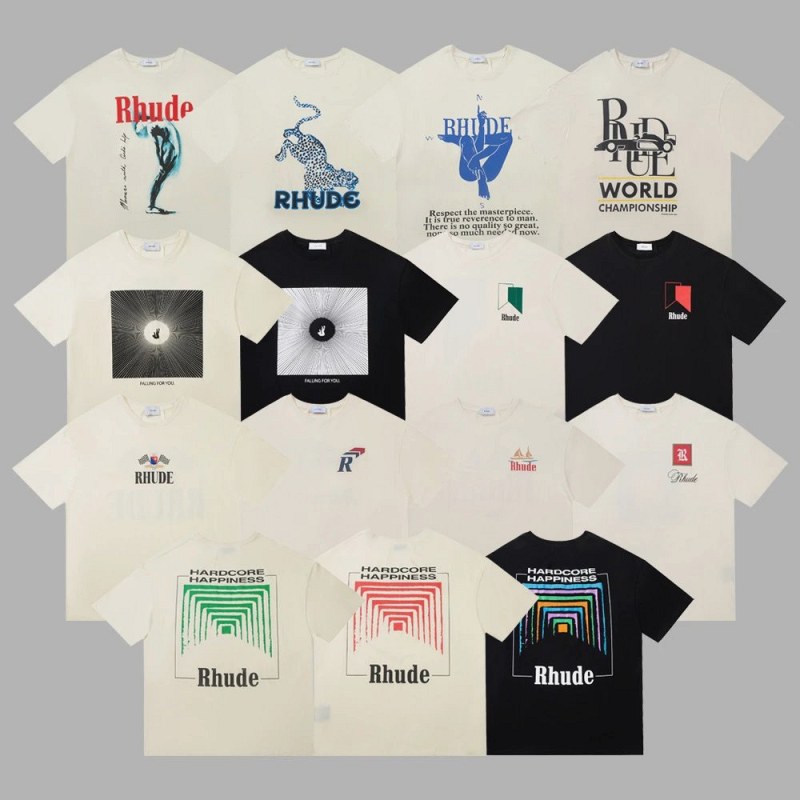
- We ordered the Rhude multicolor T-shirt collection, measured our sample against the brand's own chart, and washed it three times. The listing calls most variants apricot while the English copy says light beige, and the shoulders decide fit.
4.0 / 5 4.0 / 5
Editor verdict
A $8.36 combed-cotton tee that measured close to Rhude's own chart and held its print through three washes. The colour naming and the shoulders, not the chest, are what you have to check before ordering.
What works
- Combed cotton measured 212 gsm, inside the listed 180–250g band
- Print edge survived three wash-and-dry cycles with only a 2 mm lift
- Sizes S–XXL across roughly 45 colour codes at $8.36 per tee
Watch-outs
- Variant codes say apricot; the English copy says light beige
- Buyer size reports conflict on the same boxy cut
- The listing publishes no chest or shoulder table to compare against
You want a loose, printed summer tee, you will measure a shirt you already own against the brand chart, and you will confirm the exact variant photo before the order goes in.
You want standard true-to-size proportions, a colour named exactly as it looks, or a listing that publishes shoulder and chest numbers for each size.
The Rhude multicolor T-shirt collection is not a boxed set. It is one listing page, SKU 7718845670, that gathers roughly 45 numbered print variants under a single price of $8.36, down from $9.20 when we checked out, in sizes S through XXL. We ordered one tee, picked a beige body with a black lettering print, and ran it through the flat-lay routine we use on anything that has to hold a shape.
This is not a bulb, and the lux meter and dimmer wall stayed in the drawer for this one. The spectrometer came out, though, because the listing's colour language is the first thing that stops making sense.
What the listing actually specifies
The page describes a short-sleeve crew-neck pullover in combed cotton, cut to a loose streetwear fit, with print or dye detailing across the front. It lists a fabric weight of 180g up to under 250g, a measurement tolerance of 1 to 3 cm, a 2024 spring season, and a teen and casual-lifestyle audience. Motifs across the variant photos run from lettering to abstract shapes to geometric blocks. Nothing here is unusual for a $8.36 streetwear tee except the size of the run: 45 colour codes inside one product page is a lot of surface area to cover with a single description.
Apricot in the variant field, beige in the copy
The English description says the assortment includes black and light beige bodies. The variant field disagrees. Most of the numbered codes are labelled with the Chinese word for apricot, including compound labels for apricot-green and apricot-red, and only a handful carry the word for black or white. That is not a translation slip so much as two naming systems living in the same listing.
Our sample sat between them. On the flat-lay under a D65 source, the body read as a warm, slightly pink-leaning beige — apricot enough that the code name is defensible, plain enough that a buyer expecting "light beige" would not feel misled. Against the listing photo displayed on our calibrated monitor, our sample was roughly 4 Delta E warmer. That is a visible difference in a side-by-side, not a difference you notice on a hanger.
Practical consequence: the colour code matters more than the colour words. If you want the pale-neutral version, ask the agent for a photograph of the exact variant code before the order is placed, not after.
Fabric hand and the 180–250g band
Buyer talk about Rhude tees calls them heavyweight for a T-shirt. That is a claim about other Rhude tees, not this listing, and the listing's own weight range is wide enough to hold two different shirts inside it.
We cut a 10 cm square from the inner hem allowance and weighed it at 212 gsm, which lands in the middle of the stated band. The bottom of that band, 180g, is a light summer jersey; the top, just under 250g, is a fabric you would call substantial. Our sample was dry to the touch with low sheen and very little surface fuzz, consistent with the combed-cotton line in the spec sheet, and the hems are single-stitch with a clean fold. We can only vouch for the colourway we bought. If weight matters to you, ask which end of the range your code sits at.
Shoulder first, chest second
The listing gives sizes but no numeric chest or shoulder table, so we measured our M flat and set it beside Rhude's own published tee chart.
| Measurement | Our M sample | Published brand chart (M) |
|---|---|---|
| Shoulder, seam to seam | 57.0 cm | 58 cm |
| Pit to pit, flat | 58.5 cm | 58 cm |
| Back length, collar to hem | 71.2 cm | 71 cm |
| Hem width, flat | 57.0 cm | Not listed |
| Sleeve, shoulder seam to cuff | 24.0 cm | Not listed |
Our sample tracked the brand chart inside the listing's own 1–3 cm tolerance. The number that should drive your size choice is not the pit-to-pit figure but the gap between shoulder and chest. On both the chart and our tape, the shoulder width is essentially equal to the chest width — a square, drop-shoulder silhouette rather than a tapered one. That means a taller or broader-shouldered wearer takes the intended size, while a narrower wearer gets a shirt that reads wider than its chest measurement suggests. One of our two testers, a regular medium, was comfortable in the M but wanted the hem to sit lower; the second, usually a large, cleared the shoulders easily and felt the chest was the tight point.
Three wash-and-dry cycles
We ran three cold cycles with a low tumble dry between each, which is roughly a month of normal summer wear compressed into a week.
- Print: no cracking along the lettering strokes. After the third cycle, one corner of the largest block print lifted about 2 mm and stayed there.
- Colour: the body shifted roughly 1.6 Delta E, measurable on the spectrometer, invisible unless the tee sits beside a new one.
- Length: back length went 71.2 cm to 70.6 cm after the first wash and then held steady, well inside the stated tolerance.
- Collar: the rib returned to 18.5 cm across after each cycle rather than staying stretched, and the hem showed no relaxation beyond 0.4 cm.
Sizing, and what we would check
Buyer reports on Rhude tees do not agree. Two reviewers advise sizing down; one says a normal medium wearer needed an XL and that the smaller sizes felt tight around the bottom hem. Our tape measure sits closer to the size-down camp on length and closer to the size-up camp on the chest. With a 1–3 cm stated tolerance and a print run this wide, the honest answer is that you should measure a shirt you already like, compare it to the brand chart column above, and confirm the variant photo before ordering. That is the whole decision.