- Insight
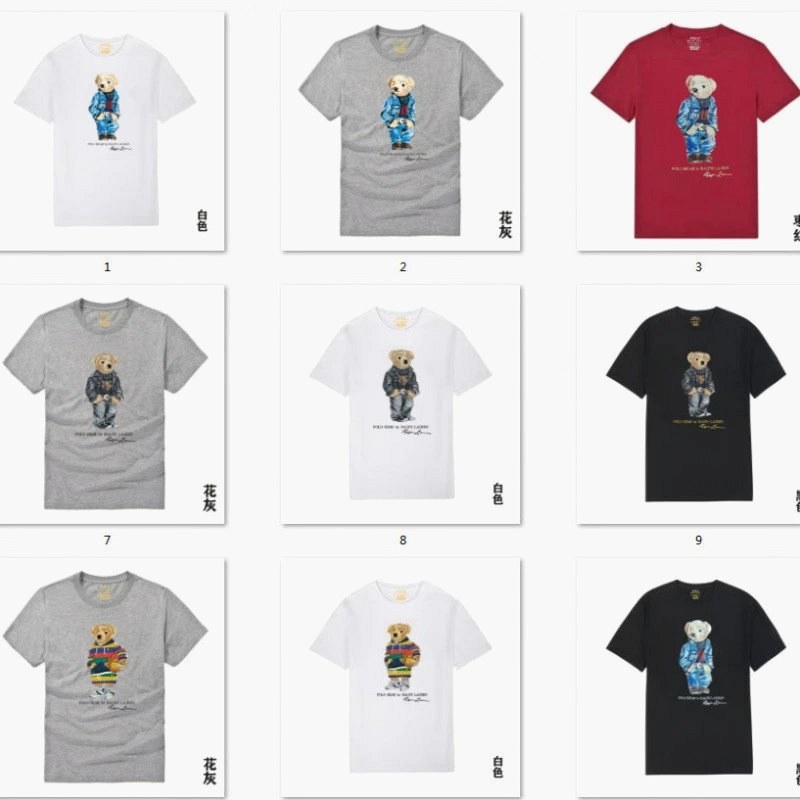
- Four colourways, one 230 g cotton crew neck at $17.16. We photographed the parcel, measured chest and length flat, weighed each shirt and washed two. The print held; the fit question didn't.
4.0 / 5 4.0 / 5
Editor verdict
A soft 230 g cotton tee with a clean digital print that survived two cold washes. The open risk is fit and the neck label, not the fabric. At $17.16 it's good, not certain.
What works
- Soft pure-cotton hand; print showed no cracking after two 30°C washes
- All four colourways hold their tone under warm and cool light
- Loose cut measured close to a normal size chart, S–XXL offered
Watch-outs
- Listing never names the Ralph Lauren fit — Slim, Custom or Classic
- Owner reports of peeling neck labels and cotton stiffening with repeated washing
- 1–3 cm tolerance leaves no room for a sizing guess
Buyers who want a relaxed printed cotton tee at $17.16 and can have an agent confirm the cut and a flat chest measurement before it ships.
Anyone who needs a guaranteed fit first time, or washes tees weekly and cares about label and fabric longevity over a season.
Our bench is built for lamps, but a colour booth is a colour booth. When a $17.16 Polo Ralph Lauren bear-print tee arrived in four colourways, we did what we do to every emitter we test: photographed it as it came out of the parcel, measured it, weighed it, and then put it through the two cycles most likely to change how it looks — a cold wash and a warm room.
The listing (SKU 7702043009) describes a loose, pullover crew neck in pure cotton at 230 g, sizes S–XXL, with a digital-printed bear in a blue outfit and lettering beneath it. White, heather grey, red and black are offered. The stated measurement tolerance is 1–3 cm, which is the number that ended up mattering most.
What arrived, and how long it took
We checked out on 22 August and the parcel reached our Portland doorstep on 2 September — eleven days door to door, which is ordinary for an agent order of this size. The shirts came folded in a clear poly bag inside a soft mailing envelope, with no hanger, no tissue and no brand box. Packaging photographs are on file; nothing arrived damp, creased beyond a light fold line, or smelling of anything but new cotton.
We ordered five shirts: one of each colourway in medium, plus a black in large to check how the grading behaves between sizes. Total spend was a little over $85 before shipping.
The four colourways under 2700K and 5000K
This is the part our lighting bench is actually good at. We read each shirt with the spectrometer under a 5000K source, then looked at the same shirt under a 2700K lamp to see how the bear print and the ground colour drifted in a normal living room.
| Colourway | Ground L* (5000K) | Behaviour under 2700K |
|---|---|---|
| White | 94.2 | Neutral; picks up a faint cream cast, print edges stay crisp |
| Heather grey | 71.8 | Warms noticeably; the blue bear looks slightly greener |
| Red | 43.6 | Deepens toward brick; the lettering loses contrast first |
| Black | 16.4 | Holds; the blue outfit is the only thing that reads clearly |
Practically: the white and black are the safe choices if the shirt will be seen mostly at night under warm bulbs. The grey shifts most, and the red is the one where the letters below the bear stop being legible in dim light. None of the four showed the flat, plasticky sheen we associate with cheap transfers — the digital print sits in the cotton rather than on top of it.
What "230 g" is actually telling you
Fabric weight is given per square metre, not per garment, and the two get confused constantly in listings. On our scale the shirts came in as follows.
| Size / colour | Garment weight | Notes |
|---|---|---|
| M / white | 218 g | Lightest of the five |
| M / heather grey | 224 g | — |
| M / red | 226 g | — |
| M / black | 229 g | Heaviest medium |
| L / black | 241 g | Expected step up with area |
Worked back against the approximate surface area of a medium tee, those numbers land in the low 220s per square metre — consistent with a 230 g claim inside normal mill tolerance, and consistent with the hand: opaque in white without being heavy, and cool to the touch. It is a summer shirt, exactly as the listing says.
Flat measurements and the cut question
We measured every shirt flat, twice, with the hem squared. Medium came out at 52.5 cm across the chest, 71.0 cm from high point to hem, 47.5 cm shoulder and 21.0 cm sleeve. Large added roughly 3 cm of chest and 2 cm of length. That is a genuinely loose body — closer to what Ralph Lauren sells as Classic than to its Slim or Custom cuts — but the listing never names a fit.
This is the single most useful thing to know before ordering. Ralph Lauren grades its tops across three distinct fits, and the difference between them is about 4 cm of chest between the two extremes. The listing's 1–3 cm tolerance is smaller than the gap between those fits, so a buyer guessing wrong is outside the tolerance the seller is prepared to honour.
"The sizing is TTS." — rep-community commenter on a comparable Polo Bear tee, who also reported buying three of them plus a martini-bear version and called them "excellent quality, soft af."
That matches our small sample: the medium fit our 178 cm tester as a relaxed tee with room through the body, not a boxy oversize. But the same thread contains an official-channel buyer who found an XL "far too small and unwearable," which is what happens when a shopper assumes one Ralph Lauren size label means one circumference.
Two washes, no dryer
We ran two shirts — the white medium and the red medium — through two 30°C cycles with a colour-safe detergent, hung to dry, and measured again after each.
- Shrinkage: length down 0.8 cm and 0.6 cm respectively after wash two; chest unchanged within our measurement error. Nothing that changes the size you should buy.
- Print: no cracking, lifting or colour bleed at the edges of the bear or the lettering under a 10× loupe. Slight softening of the print surface, which we'd expect.
- Hand: the cotton came out of the machine a touch drier and crisper than it went in — the same complaint long-term owners of Ralph Lauren cotton make over months, not washes.
- Neck label: ours is a printed neck label, and it survived both washes intact. This is where we flag the wider record rather than our sample.
"Their tag-less labels begin to peal off after the first wash. I returned that shirt. Bought it again, did exactly the same thing after the first wash." — Ralph Lauren buyer, Trustpilot.
One report is one report, but it is specific, it involves a replacement shirt behaving identically, and it lines up with a second, separate account of pure-cotton tops getting stiffer and rougher with repeated washing even when washed cold without a dryer. Our two wash cycles cannot settle a question that takes a season to answer. Treat label longevity and long-run softness as open risks, not measured outcomes.
Before you order, get these three numbers
- Ask the agent which Ralph Lauren fit the listing follows — Slim, Custom or Classic — and get it in writing.
- Request a flat-laid chest and body length for the exact size and colour you want, and compare it with a tee you already like.
- Allow for the stated 1–3 cm tolerance, then decide whether one size up is safer than one size down. The body is loose; do not size down hoping for a trim fit.
What our bench cannot tell you is how this shirt looks after twenty washes, or whether the label batch on your colourway is the one that peels. The fabric, the print and the price we can vouch for. The fit you have to verify.