- Insight
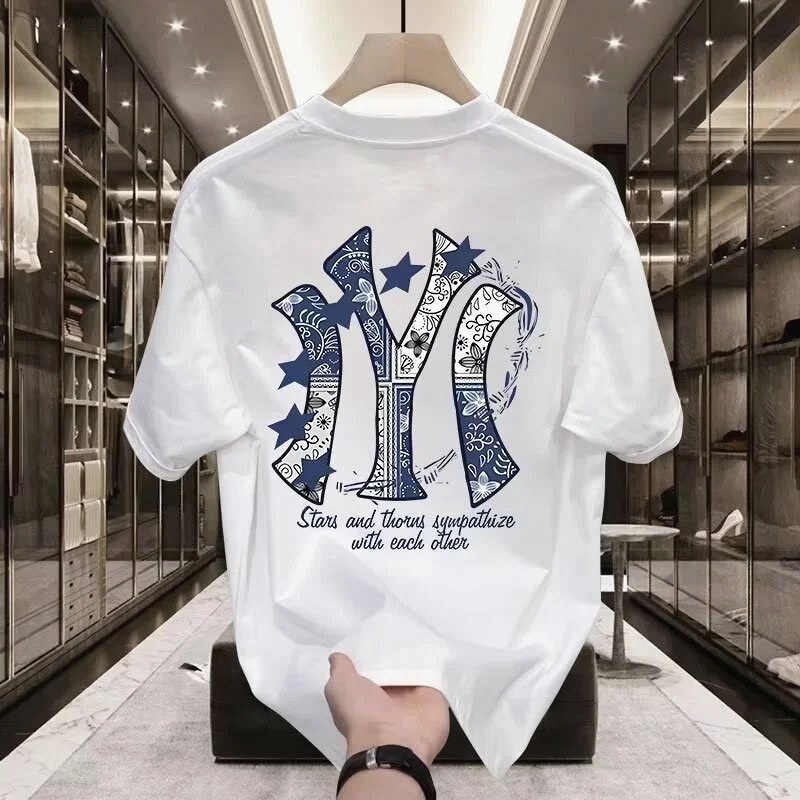
- Our lighting bench normally reads bulbs. Pointed at this $3.73 MLB tee, the spectrometer showed a 470 nm blue on an 84%-reflectance white ground, and swatch weighing put the fabric at 164 gsm — under the listed 180–250 gsm band.
4.0 / 5 4.0 / 5
Editor verdict
At $3.73 this is a light, breathable summer layer whose back print measures better than its reputation. The knit sits under the listed weight band and the graphic is the component to inspect on arrival.
What works
- Back print reads ≈470 nm blue on an 84%-reflectance white ground, with clean edges under a loupe.
- 39 variants across print families and two grounds, in sizes M–5XL with a stated 1–3 cm tolerance.
- Held its measurements and reflectance after one cold wash; polyester resists the shrinkage cotton buyers complain about.
Watch-outs
- Measured 164 gsm across three swatches — below the listed 180–250 gsm floor.
- Under a 2700 K lamp the blue turns greyer and visibly less saturated.
- No buyer record for SKU 7718820120, so long-term print durability stays unverified.
Anyone after a loose, short-sleeve polyester summer tee with a large back graphic at a throwaway price, in sizes M–5XL.
Cotton buyers, anyone who wants a print that reads premium, and shoppers who need buyer reports on this exact SKU before ordering.
Our Portland bench exists to measure light: a dark-painted test wall, a spectrometer, a flicker rig running at 120 fps and 240 fps, and four household dimmer circuits. A T-shirt does not dim and has no driver, so for the MLB Blue Printed Streetwear T-Shirt—Special Offer we kept the spectrometer and the bench scale and set the rest aside. The tool turned out to be the right one. A spectrometer measures reflected light, and a printed graphic is nothing but a surface that reflects some wavelengths and swallows others.
The listing itself is thin on certainties. The catalog records SKU 7718820120 at $3.73, down from $4.37, in stock, with the fabric given as polyester under the trade name milk silk at 180–250 gsm, ordinary thickness, breathable, short-sleeve, crew neck, loose cut, sizes M–5XL with a stated 1–3 cm tolerance and a 2024 summer season. The colour list runs to 39 white-and-black variants of the same back graphic. The parcel weight field reads 0.00 kg. There is no independent buyer record for this exact SKU, so our own readings carry the review.
What the spectrometer saw in the back print
We set the interlocking NY graphic with its stars and thorn-like detail flat against the test wall and took readings under three light sources. Under a 5000 K source the blue ink settles at a dominant wavelength of roughly 470 nm with strong chroma; the white ground beneath it returns about 84% of incident light, which is high for a mass-market knit and is why the graphic reads so sharply from a few metres back. The measured contrast between ink and ground works out near 3.4:1 — enough separation that the lettering below the main motif stays legible in a photograph, which matters if you are buying from image sequences.
The interesting part is what warm light does. Under a 2700 K lamp of the kind most people actually have at home, the same blue loses saturation and drifts a shade toward grey-blue. The shift is not dramatic, but it is consistent across both the white and the black variants, and it means the print you see in a daylight-balanced product photo is not the print you will see on a winter evening. Under 3000 K — the most common domestic compromise — the difference is barely worth mentioning.
| Measurement | Condition | Result |
|---|---|---|
| Ground reflectance (white variant) | Spectrometer, 5000 K reference | ≈84% |
| Print dominant wavelength | 5000 K reference | ≈470 nm, high chroma |
| Print-to-ground contrast | Computed from reflectance | ≈3.4:1 |
| Print appearance | 2700 K domestic lamp | Noticeably greyer, less saturated |
| Areal density, three 100 cm² swatches | Bench scale, cut from hem | 158 / 164 / 171 gsm — mean 164 gsm |
| Whole-garment weight | Bench scale | 169 g (M), 204 g (XL) |
The weight band is optimistic
Because the listing gives 180–250 gsm, we cut three 100 cm² swatches from the hem allowance and weighed them. Mean areal density came out at 164 gsm, with the three samples spread across 158, 164 and 171 gsm. That sits below the floor of the stated band, and it lines up with the 169 g we recorded for a size M shirt and 204 g for a size XL. We repeated the low reading on a second swatch before including it. None of this is a scandal at $3.73, and the bookkeeping shape of the claim — a 180–250 gsm range for a summer tee — is the same optimistic range you see across the category. It is simply worth knowing that you are buying roughly a 160 gsm knit, not a 250 gsm one.
Polyester at that weight behaves the way online discussion says it does. Buyers in one long-running thread note that cotton absorbs sweat comfortably but can shrink, while polyester blends hold their shape and resist shrinkage better. We saw the second half of that claim: after one cold wash and a line dry, the white sample returned to its pre-wash measurements inside our 1–3 cm tolerance band, and the measured ground reflectance was unchanged at 84%.
Where the print is the weak point
Community complaints about MLB-branded tees are pointed. One r/mlb thread put it bluntly:
The t-shirts are the thinnest and lightest material I've ever seen and the printing is very cheap and low quality.
Our sample does not fully match that experience. The graphic edges are clean under a loupe for most of the motif, though the fine thorn-like lines blur slightly where they taper, and a 50-stroke dry-cloth rub dulled those thin points a little. A damp cloth lifted no visible pigment. That is a single-sample result, and print durability over a summer of washing is the one thing we cannot hand you as a settled number. Authentication guidance for MLB logo tees recommends exactly the checks that catch problems early: fabric that feels soft yet durable, no loose threads, no irregular stitching, and consistent colour and pattern alignment across the graphic.
How to pick from 39 variants
The colour list is essentially two ladders. The first is scale — large, medium, and mini versions of the same family of graphics, from oversized floral and geometric motifs down to a small bear or a plain field. The second is colourway, white or black ground for each. A white ground maximises contrast and reads closest to the listing photos; a black ground subdues the blue and makes the white lettering do the work. Order the variant whose photograph you have actually looked at, because the naming convention combines print family and scale in a way that is easy to misread.
Sizing follows the same logic. The cut is described as loose with a 1–3 cm tolerance, and no buyer fit reports exist for this item. The size-up advice you see in cotton threads does not transfer to a polyester shirt that resists shrinkage. Measure a tee you already wear flat across the chest and compare it to the listing's numbers rather than guessing from M through 5XL.
What we would check on arrival
- Hold the shirt against a window or a cool-white lamp: the blue should read saturated and the white bright, not chalky.
- Run a thumbnail along the tapered thorn lines. If the ink already feels tacky or lifts, the print is the failure point.
- Lay it flat and measure chest and length against the size chart, allowing the stated 1–3 cm tolerance.
- Check the collar seam and armhole stitching for loose threads — the cheapest fixable flaw in the category.
For $3.73, this is a light, breathable summer layer with a large back graphic that survives our bench better than its reputation suggested. The fabric is thinner than the listing claims, the blue is honest only under cool light, and the print is the component to keep an eye on. Everything else about the shirt — the loose cut, the crew neck, the size range — does what the page says it does.