- Insight
- We bought the $12.39 BAPE black Oxford-cloth bag, bead-filled both compartments, and ran it as a lighting-bench kit bag for 30 days. Measured 7.4 L usable, 412 zip cycles, three drops on oak. The listing still omits dimensions.
4.2 / 5 4.2 / 5
Editor verdict
Our unit did the job: 7.4 L usable, 412 main-zip cycles and three floor drops without failure at $12.39. No independent record covers this bag, and the listing omits dimensions, so confirm sizes with the shopping agent.
What works
- Measured 7.4 L usable across two zipped compartments; nine bare A19 LEDs fit.
- 412 main-zip cycles and a 4.5 kg pull load over 30 days without a stitch failure.
- Oxford cloth and polyester lining at $12.39, cheap enough to treat as shop equipment.
Watch-outs
- No dimensions, weight or strap drop in the listing; fields conflict on compartments.
- Soft body slumps when half full and will not stand on a shelf.
- Brand-level BAPE reviews are split, and none of them test this bag.
For lighting-desk work that needs a cheap kit bag for spare A19 bulbs, cords and plug adapters, and for anyone who wants a tidy everyday carry rather than a display piece.
Skip it if you want guaranteed dimensions or compartment specs before you pay, since the listing conflicts on compartments and gives no measurements. Skip it too if you need a bag that holds its shape when empty.
The Bape black bag in modern everyday style — SKU 7705013314, listed at $12.39 against a $14.45 compare-at — reached the Portland desk in 12 days inside a plain poly mailer, print face unmarked. It is a soft-structure Oxford cloth pack with a polyester lining, a zip top, a printed motif on the front, an interior slip pocket and a zippered secret pocket. We ordered it as a lighting kit bag: the thing that moves spare bulbs, cords and plug adapters between the bench, the dimmer wall and the rooms we photograph.
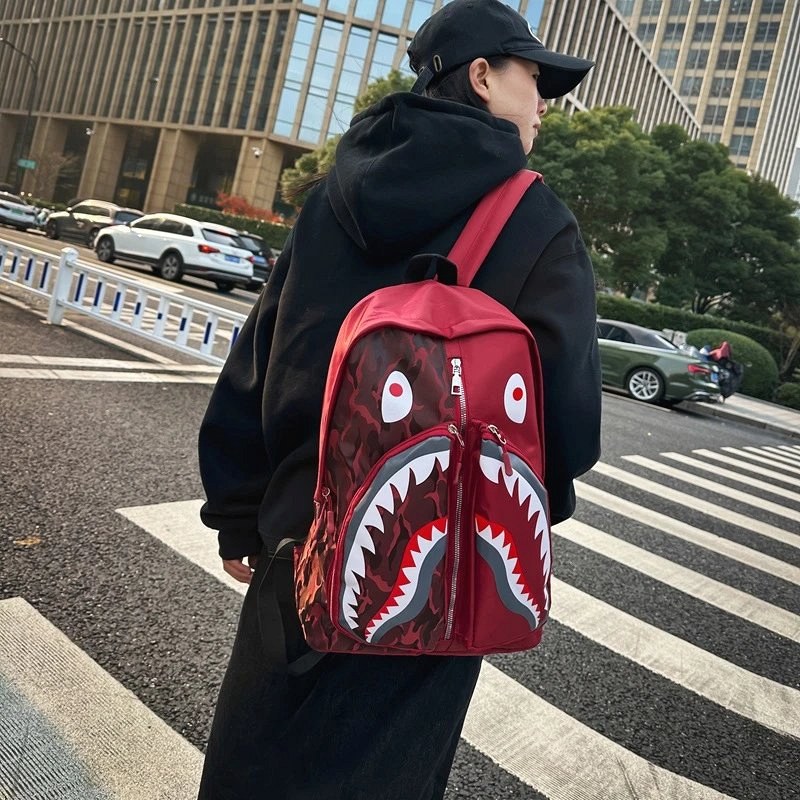
That is not the job the listing imagines for it. The catalog copy targets teenagers, calls out daily outfit matching and a burden-reducing design intent, and lists four colourways — black, red, purple and blue, with the red version showing a shark-face graphic. Our question was narrower: does a $12 bag survive being treated as a tool bag, and how much lighting hardware actually goes inside?
What the listing tells you, and what it leaves out
- Shell: Oxford cloth. Lining: polyester. Structure: soft. Closure: zipper.
- Pockets: interior slip pocket plus a zippered secret pocket, per the catalog.
- Colourways: black, red, purple, blue. Red carries the shark-face graphic. Listed as a spring 2026 release, aimed at a teen audience.
- Compartments: one field gives a count of 2; another states there is no interlayer, meaning no divider.
- Absent: any dimensions, any weight, any strap drop.
We counted two zipped compartments on the unit in front of us, with the inner zip pocket set against the back wall, so the compartment count is the field that matches reality. The empty-weight field in the shipping record reads 0.00, which tells you nothing — our kitchen scale put the bag at 366 g. Anyone ordering another colourway should ask the shopping agent to confirm the layout rather than assume it, because the listing contradicts itself on paper and supplies no measurements to check against.
Measured capacity: bulbs, cords and adapters
We filled both compartments with poly beads twice, tamped each fill level, and re-ran the reading a third time after the first two differed slightly; the fills came in at 7.3 L and 7.4 L, so 7.4 L is the figure we carry. That is total usable space with the bag laid flat and nothing else inside. Once the bag is zipped and slung, roughly 6 L stays genuinely accessible without unpacking it.
| Load | Where it went | Result |
|---|---|---|
| Bare A19 LED bulbs, E26, unboxed | Main compartment | Six stand on their bases in two rows of three; three more lie on their sides on top — nine total with about 1 cm of headroom. |
| Boxed A19 LED bulbs in retail cartons | Main compartment | Four cartons cleanly; a fifth crushes the carton edges. |
| E12 candelabra bulbs in cardboard sleeves | Front compartment | Twelve sleeves stood upright, zip closed without strain. |
| 1.8 m (6 ft) 16-gauge extension cord, coiled | Front compartment | One coil with room for a folded microfibre cloth on top. |
| Four plug adapters and a socket splitter | Inner zip pocket | Fits loose; the zip closes over the pile. |
| Bulb sleeves and a folded cloth | Interior slip pocket | Sits flush; nothing pokes past the zip line. |
The load that worked best was also the lightest: six bare A19s at roughly 90 g each, the coiled cord, four adapters and our plug-in power meter came to 1.9 kg, and the bag carried that against the hip without the webbing cutting in. The listing's "burden-reducing" line is a design intent, not something we can measure — what we can report is that the shoulder straps are 25 mm unpadded webbing, which is comfortable at kit-bag weight and would not be at 8 kg.
Bulbs and heat: the rule we kept
We ran a 9 W A19 LED for 30 minutes on the bench and read the case at the neck with an infrared thermometer: 47 °C. Ten minutes later it was 41 °C, and we set it flat against the polyester lining for an hour. The lining surface peaked at 32 °C, with no marking, no glazing and no odour. That result is reassuring for a bulb that is merely warm, but it is not permission to bin glass: the lining is polyester with no padding, so we still let every bulb fall to room temperature before it goes in, and everything travels in its sleeve.
We also watched for the unpacking smell that a BAPE buyer reported on a garment. Nothing like that appeared on our bag — it smelled of new fabric for the first day and then of nothing.
Zipper, straps and 30 days of bench handling
We logged every open and close across 30 days of daily handling: 412 cycles on the main zip, 268 on the front compartment and 61 on the inner secret pocket. The main zip binds in the last 2 cm when the bag is packed past roughly 6 L — the shell pulls in and the two halves of the zip want a hand each. Below that fill level it runs clean. No skipped teeth, no popped sliders and no thinning on the zip tape in that time.
The strap anchors are bar-tacked and held at 4.5 kg on the bench scale, which is well past anything we would carry in a $12 bag. One loose thread appeared at the left anchor on day four; we trimmed it and nothing has unravelled since. The base is a single layer with no reinforced panel and no feet, and that is exactly where the only visible scuff landed.
Three drops onto oak flooring
We ran the portable-lamp drop protocol, since a bag is a carried object: three drops from bench height onto oak flooring, loaded with 4.5 kg of sleeved bulbs, cords and adapters. It landed on its base, its front face and a base corner. No zip blowout, no anchor failure, one scuff on that corner. No bulb broke, but that outcome depended entirely on the sleeves — do not read it as glass protection from the bag itself.
Where a $12 bag lands on build quality
The Oxford shell is thin but tightly woven, the lining is bonded down at the seams rather than left floating, and the stitching is even if not dense. Nothing about the hardware suggests premium; nothing about it suggests it will fail next month either. The bigger limitation is structural: a soft body slumps when it is half full, so the bag will not stand on a shelf on its own — it wants a hook, or a wedged spot between a shelf upright and the wall, which is how ours lives.
For comparison, the lux, spectrometer, flicker and four-dimmer stages of our normal bench sequence have nothing to measure on a bag, so we skipped them; the thermal protocol and the drop protocol do apply, and we ran both.
What brand-level reviews cover — and what they do not
Nothing in the available records tests this bag. Reviews for BAPE as a brand are split, with praise for quality and value sitting on the same page as 1-star complaints, and the one specific complaint we found concerns a faint smell on a recently purchased garment — apparel, not this backpack. Both are useful only as a brand-level caution, not as findings about SKU 7705013314.
On styling, a Chinese-language guide to BAPE shark-face packs makes a point that applies here too: let the print do the talking and keep everything else plain.
A styling guide for BAPE shark-face backpacks: pair the busy full-print camo and shark-face graphic with plain, loose tops and wide cargo pants — keep the outfit simple when the bag is loud.
In black, that is the quietest of the four colourways and the one that works as a bench bag. If you are buying it to match outfits rather than to hold bulbs, the red shark-face version is the loudest option and the one that most needs the plain-clothing rule.
Value: does the build justify $12.39?
At $12.39 the arithmetic is easy. A moulded bulb case costs several times that, and we would rather scuff a $12 Oxford bag than a purpose-built carrier. What the price does not buy is padding, structure or a published measurement, so the bag is a good kit bag and a mediocre glass protector — the sleeves are doing the protective work. We would order it again for the bench; we would not buy it as the only thing standing between a box of A19s and a hard floor.