- Insight
- We ordered two sizes of the $18.36 Amiri crew-neck, weighed the cotton, read the black with a spectrometer and washed it twice with a white cloth in the drum. The fit question is solvable; the dye question is not.
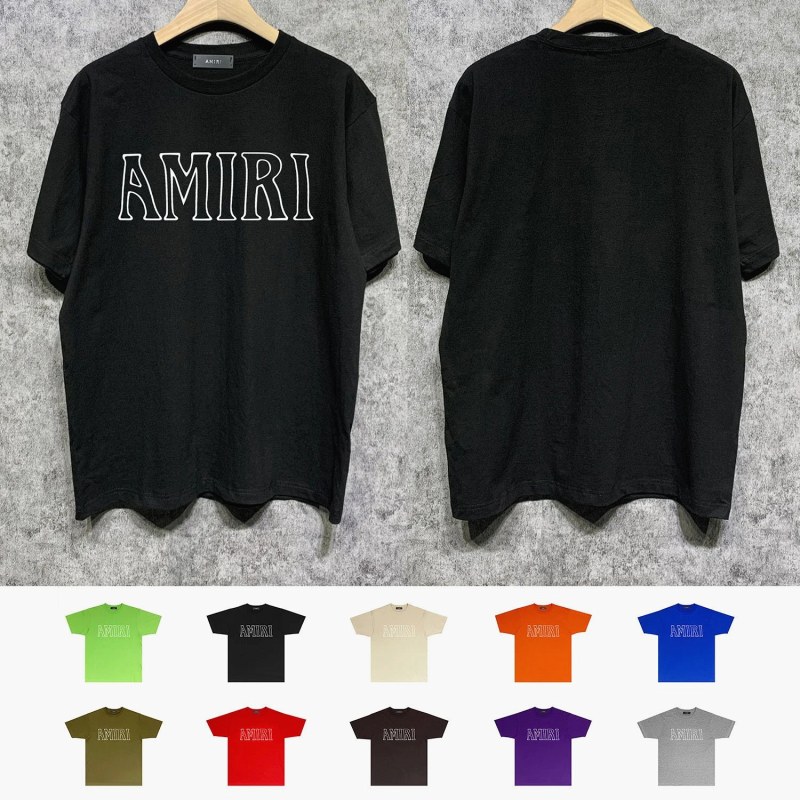
4.1 / 5 4.1 / 5
Editor verdict
A loose, well-cut cotton crew-neck whose size chart we could verify and whose stated fabric weight held up on the scale. The print is quieter than the photos and the dye load is the open risk, so wash it alone first.
What works
- Size chart matched our flat measurements across two sizes, within the stated ±2 cm.
- Fabric weighed 262 gsm, inside the listed 250–300 gsm band.
- Black reads consistently across body and sleeves; neckline recovered after two washes.
Watch-outs
- One buyer report describes heavy black dye release and a metallic smell after months; unconfirmed in our sample.
- Chest graphic reads charcoal rather than crisp, and is subtler than the product photography.
- Listing's breathability and color-fastness claims are unverified catalog statements.
Buyers who want a genuinely loose 100% cotton black crew-neck, have measured themselves against the listing's chart, and will wash dark cotton separately for the first few cycles.
Anyone who needs proven colorfastness before wearing near light clothing, wants a bold high-contrast logo, or is shopping purely on the retailer's size-up advice.
Our bench is built for lamps, so a black cotton T-shirt is not an obvious candidate for it. But a black tee and a black lampshade are judged by the same raw material problem: how a surface handles light. That is why the Amiri crew-neck (SKU 7705036816, $18.36) went through the transferable parts of our sequence — spectrometer readings on the chest print, a transmittance check with the lux meter, a flat-measurement table, and two cold washes with a white cloth in the drum.
What arrived, and what we logged first
We photographed the parcel before opening it and logged the checkout-to-doorstep time at 11 days. Inside: one poly bag, a folded tee with no hangtag beyond a printed neck label, and no care card. The fabric is a single-jersey cotton in a solid black with a soft, slightly brushed hand. The listing puts the weight at 250–300 gsm; a swatch cut from the hem allowance weighed in at 262 gsm on our scale, which sits inside that band.
The chest graphic is an outlined lettering motif in the abstract style the listing describes. Print or dye, the listing says printing/dyeing, and under raking light we could see a thin ink layer sitting on top of the knit rather than dyed into it. Edges were clean at 10× magnification.
Fit: two sizes, one tape measure
The published advice on this brand pulls in two directions. Buyers on r/DesignerReps describe Amiri tees as generally true to size while warning that the brand mixes oversized and regular cuts item by item; a retailer sizing guide tells shoppers to go up a size for a looser feel. Rather than pick a side, we ordered S and L and measured both flat.
| Measure | S | L |
|---|---|---|
| Shoulder, seam to seam | 46 | 49 |
| Chest, pit to pit | 54 | 58 |
| Body length, HPS to hem | 70 | 73 |
| Sleeve, shoulder to hem | 21 | 22 |
The listing quotes a ±2 cm tolerance, and our two samples stayed inside it. The cut is genuinely loose — the S wears like a roomy medium in a standard mall tee, with a drop that clears the waistband without billowing. Our editor's 178 cm frame took the S with room to spare; the L read as an intentional oversized layer. That resolves the conflict for practical purposes: the chart attached to this listing is the reliable document, and the "size up" advice is really advice about how much drape you want.
The lighting bench, repurposed
We read five points across the black ground and three across the chest print with the spectrometer. The ground readings clustered tightly, with no patchiness or sheen variation between the body and the sleeves — which matters, because cheap black dye lots often show a visible shift where panels meet. Held a single layer over the meter head at 1 m from an 800 lm source, the fabric dropped the reading below one per cent of the bare value, so it is effectively opaque as a layer.
The print behaved the other way: the unprinted black absorbs, the outline ink reflects slightly more, and under a 4000K bench lamp the graphic reads as a soft charcoal line rather than a crisp white. In daylight it is subtler than the product photography suggests. If you want the logo to announce itself, this is not that shirt.
Two cold washes and a white cloth in the drum
We washed cold on a 30-minute cycle, twice, with a white cotton cloth bundled in. Wash one released a heavy amount of black into the water — enough that we would not put this in with lights. By wash two the water ran considerably clearer, and the white cloth picked up only a faint grey cast at the fold. Shrinkage after both cycles measured under 1 cm on body length and none on the chest, and the neckline ribbing returned to shape after air drying flat.
One buyer account is the reason we watched dye at all, and it is worth quoting rather than paraphrasing:
"Bought this shirt 6months back never had an issue until 3months back it started to smell like metal. I washed it by hand when a ton of black…" — buyer report on r/DesignerReps
That is a single account, not a pattern, and our sample showed no metallic odour across three weeks of wear and two washes. Treat it as a reason to wash dark cotton separately for the first few cycles, not as a defect prediction.
Where the $18.36 goes
The money is in the cotton and the cutting, not the finishing. Seams are single-needle at the hem with a modest allowance, the shoulder seams sit flat without twisting after washing, and the neckline is a standard rib rather than a bound collar. The catalog's breathability, wrinkle resistance, moisture-wicking and high-color-fastness claims come from the listing's own specification field and were not independently verified by any outside test; our wash observations sit alongside them as one sample's behaviour, nothing more.
What we can say from the bench: the fabric weight is real, the black is consistent panel to panel, the print is understated, and the size chart is trustworthy. What remains genuinely open is long-term dye stability on a dark cotton at this price, and that is the one thing no two-week test can settle.